dev blog · · experiment
A terminal UI that is one value
An experiment, thc-scene, makes a whole terminal screen one JSON value that an agent can push, patch, drive and read back while it runs, fed by live data at thousands of updates a second.
thc’s screens are Rust. That’s fine for the screens we ship, but two things we want don’t fit it: a vault with its own, simpler screen (a writing vault doesn’t need a task board), and a screen an agent puts up for you: “here’s your week,” “here’s what changed in the build.” Both need a screen that is data, not code.
So we made a branch, stripped everything down, and tried the most direct version of the idea: the whole UI is one serializable value. It’s an experiment called thc-scene. This post is what we built in a day of agents driving it, what held up, and what’s missing.
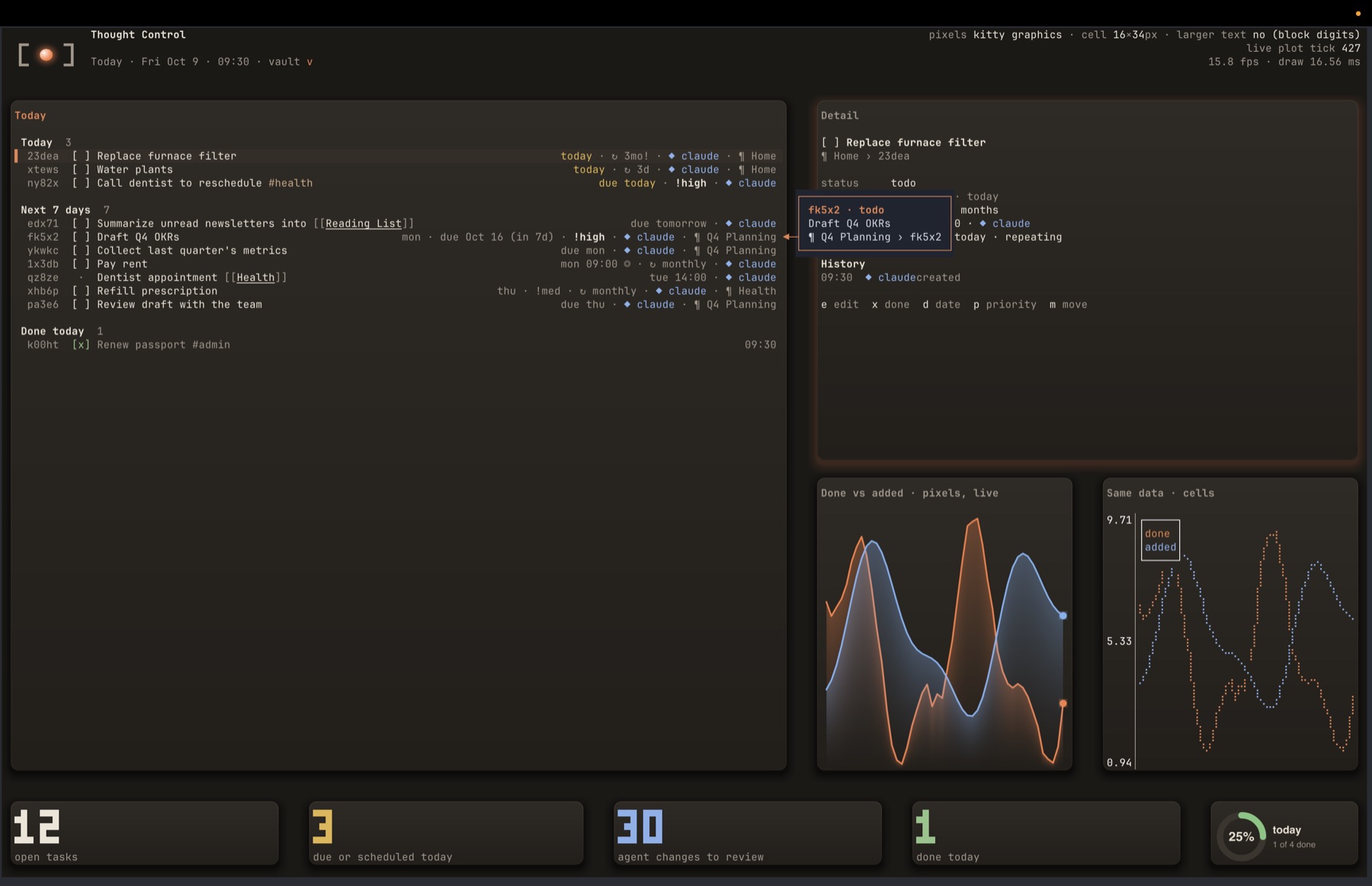
thc’s Today, rebuilt as one JSON value. An agent placed the callout; the plot on the left is pixels, the one beside it is the same data in cells.
The shape
It’s the Elm architecture, which thc already uses: a serializable State, messages, a pure
update that returns effects and a pure view. A runtime owns the terminal, a local socket, child
processes and the pixel layer. The UI is a field of the state, so it can be swapped like any
other field.
A UI is a tree of components, the data sources they bind to, and keys:
{
  "root": {"type": "row", "children": [
    {"type": "table", "id": "tasks", "title": "Open tasks", "bind": "tasks",
     "columns": [{"title": "task", "value": "{text}"}, {"title": "due", "value": "{due}", "size": 11}],
     "keys": {"x": {"run": ["thc", "done", "{id}"]}}},
    {"type": "list", "id": "pages", "title": "Pages", "bind": "pages", "item": "¶ {title}"}
  ]},
  "data": {
    "tasks": {"cmd": ["thc", "q", "status:open sort:due", "--json"], "path": "items", "every": 3},
    "pages": {"cmd": ["thc", "q", "is:page sort:title", "--json"], "path": "items", "every": 10}
  }
}
Data comes from commands, JSON-line streams or literal values. The model never sees the data: an agent writes the screen once and the numbers flow straight from the source to the terminal.
Push, patch, read back
Everything goes over a local socket, with a CLI for each operation:
thc-scene push trading.json          # the whole UI swaps, in one frame
thc-scene patch header node.json     # replace one node by id
thc-scene key j x                    # type, like a person
thc-scene mouse click 40 12          # or click
thc-scene screen                     # the frame, as text: see what you drew
thc-scene get --state                # everything, as JSON
thc-scene upgrade                    # exec a new binary; same screen, same state
View state (the selected row, the focused pane) is keyed by node id, like React’s keys, so a push
keeps your place wherever the ids still match. upgrade saves the state, execs the new binary and
restores it: you rebuild the engine and the screen carries on, same process, same selection.
Reading back matters as much as writing. An agent that can’t see what it drew is guessing;
screen gives it the frame as text, and state gives it everything behind the frame.
How fast
We wrote a stress suite and left a frame counter on screen. Release build, a 170×52 terminal, one machine:
| demo | fps | draw | messages/s |
|---|---|---|---|
| ticker, 500 updates a second | 114 | 0.23 ms | 500 |
| text plasma, 8,000 cells at 120 Hz | 110 | 0.24 ms | 122 |
| a 50,000-row list replaced 20 times a second | 20 | 0.18 ms | 20 |
| 1,000 patches a second | 116 | 0.22 ms | 1,000 |
| whole new UIs, as fast as a client can send | 108 | 0.84 ms | ~6,200 |
Three things got it there: one event queue for input, data and requests; streams coalesced so the newest value wins each frame; and drawing only what’s visible (the 50,000-row list borrows rows and draws the 50 you can see).
Does generated have to look generated?
The test we cared about most: can a scene UI match a screen we built by hand? We rebuilt thc’s Today screen as JSON (sections, rows, badges, the detail pane, ember-dark’s colours) and compared it with the real TUI cell by cell: character, colours and attributes, after the same keys. All 13 states, 78,000 cells, are identical.
That took a small template language: theme-token styles (<accent+b>…</>), value maps
({status|todo=[ ];done=[x]}), conditionals, right-aligned tails and lines that drop out when
their fields are empty. Data values can never inject styles, so a task titled <red> stays text.
Pixels, where the terminal has them
Terminals that speak the kitty graphics protocol (Ghostty, kitty, WezTerm) can show pictures, so scene uses them where they help and falls back to cells everywhere else:
- cards (rounded, shadowed, gradient panels) drawn under the text, so selections still paint over them
- anti-aliased plots with gradient fills
- SVG, rendered with resvg and filled from data (the progress ring below)
- PNGs by path, fitted to their aspect
- spotlights: a translucent sheet that dims everything but one pane
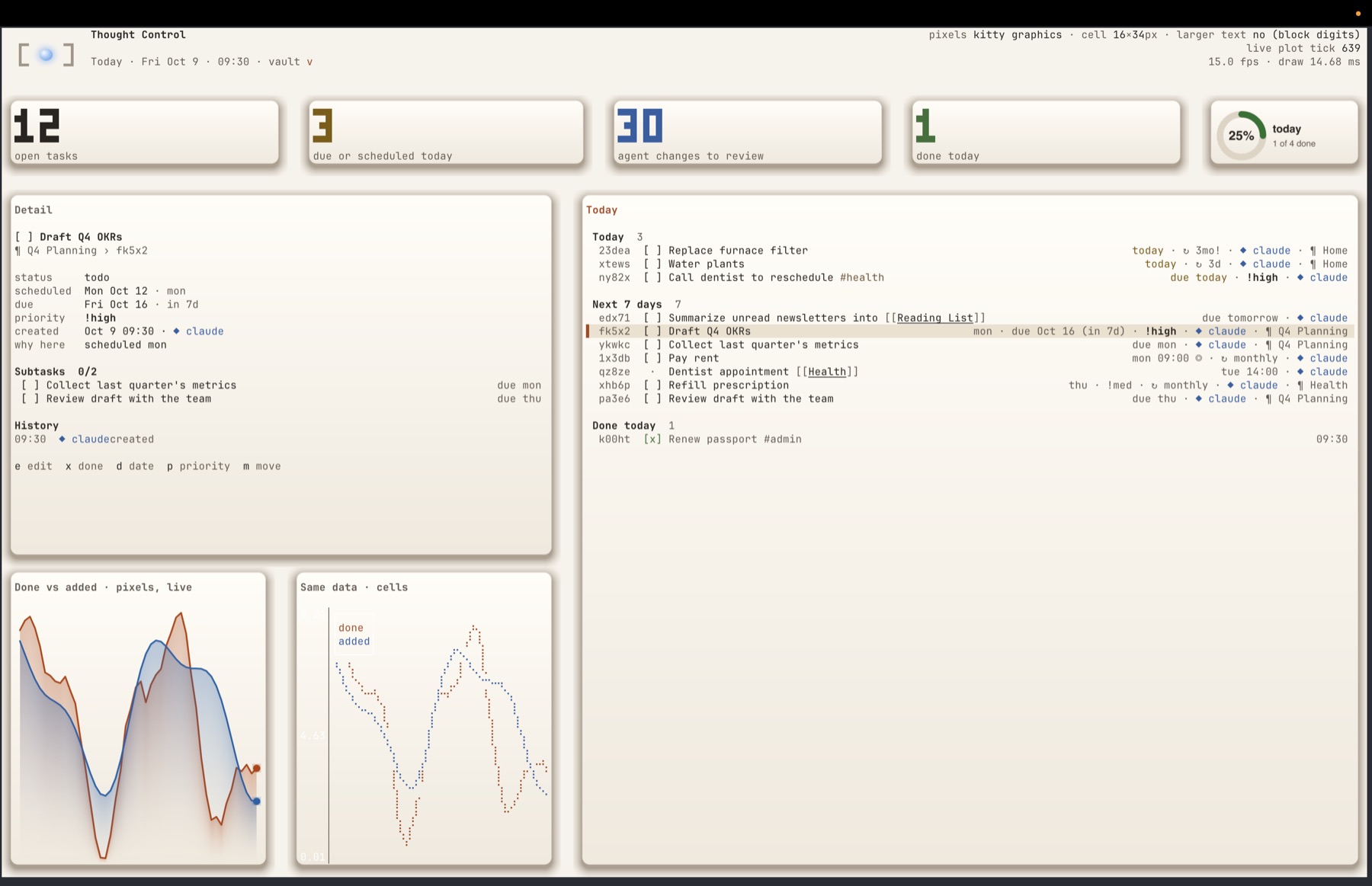
One push rearranged the screen and switched the theme. The ring is SVG with its arc filled from data.
The view stays pure: it asks for a picture in cells, colours and proportions, and the runtime rasterises it at the terminal’s real cell size, sends it once (cached by content) and moves only what moved. Larger text (OSC 66) is probed at startup; Ghostty doesn’t draw it yet, so scene falls back to block digits.
What we tell agents, in order: use components first (they’re themed, cached and degrade gracefully), SVG for anything custom, PNG only for real bitmaps, and animate the data, not the pictures.
What’s missing
This is a prototype by one author, and it shows:
- No history yet. State is serializable and every input is a message, so time travel (read, seek, fork, replay) is cheap to build. It isn’t built.
- No MCP server. Agents drive it over the socket or the CLI.
- Sources run shell commands. That’s convenient and the opposite of the field’s “data, not code” safety stance. It needs a command policy before anyone pushes a UI they didn’t write.
- Its own format. No A2UI or MCP Apps input yet.
- Pixels cost. A 15 Hz plot takes frames from under 1 ms to about 7 ms, because rasterising runs on the main thread. A worker thread is next.
- Fullscreen only, so it gives up the terminal’s own scrollback and search.
Before building more, we wanted to know whether we were reinventing something. That’s the next post.
The code is on the poc/declarative-ui branch,
with every demo in crates/scene/examples/.